
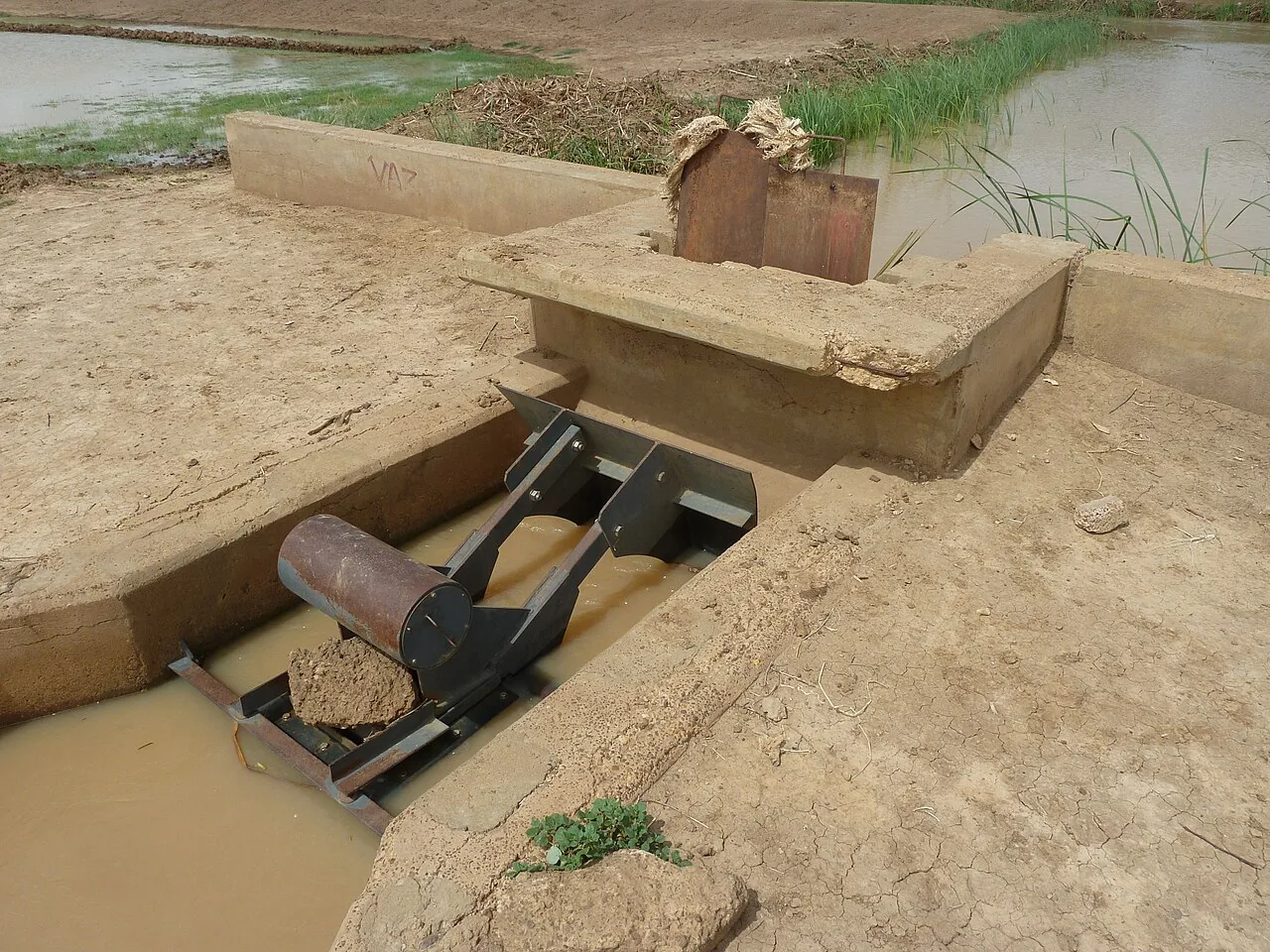
Irrigation infrastructure in Senegal’s Podor Department. Africa Rice Center, 2013. Africa Rice Center · CC BY-SA 3.0
External editorial reference; not a SUM VISUM facility or project. Credits & changesSUMAGRI
Begin with the realities of the field.
A useful agricultural tool must fit the way producers record, plan and exchange information. SUMAGRI works on farm records, cooperative workflows, agricultural data and the technical requirements of field tools.
01 / Purpose
Give producers and agricultural organizations a clearer record of their work and the information needed to plan it.
The operating context
The product brief connects farming systems rather than treating agriculture as a single crop question. Soil, water, climate, crop health, livestock, labour and markets interact. Local practice and producer knowledge must remain visible alongside digital information. The division also encompasses equipment, connected observation, agricultural infrastructure and the food system beyond production. Its application is one product within that broader architecture.
SUMAGRI / Professional services
Services and deliverables
01
Digital farming solutions
Farm records, field activity logs and operation dashboards designed around actual work practices and seasonal constraints.
- Deliverable
- Farm-record workflow/data model and scoped field-log or dashboard prototype.
Active professional service
Discuss this service02
Agricultural advisory technologies
Organize agricultural knowledge and expert-reviewed information workflows. Agronomic recommendations require qualified, location-specific validation.
- Deliverable
- Reviewed knowledge-source structure and advisory-tool prototype; agronomic validation remains separate.
Active professional service
Discuss this service03
Agribusiness management systems
Scope inventory, input purchasing, cooperative administration and supply management with clear roles, data ownership and reporting definitions.
- Deliverable
- Inventory/operations requirements, scoped management workflow and handover documentation.
Active professional service
Discuss this service04
Agricultural market intelligence
Structure market data collection, source comparison and reporting. Price freshness, geography and uncertainty must remain visible.
- Deliverable
- Source-dated market dataset/report, assumptions and data-quality limitations.
Active professional service
Discuss this service05
Supply chain & traceability
Design batch records, movement logs and digital commerce workflows. Traceability evidence depends on reliable capture, not software labels alone.
- Deliverable
- Batch/event data model, traceability workflow and agreed test scenarios.
Active professional service
Discuss this service06
Precision agriculture & connected technologies
Assess sensors, irrigation data, drones and equipment integration with specialists. Connectivity, calibration, maintenance and local operating permissions shape feasibility.
- Deliverable
- Connected-system feasibility, sensor/data specification and partner/maintenance requirements.
Active professional service
Discuss this service07
Farmer training & digital inclusion
Design practical training and multilingual, offline-first field workflows for farmers and cooperatives. Synchronization and device constraints must be tested.
- Deliverable
- Multilingual practical training plan, offline-friendly materials and learner feedback summary.
Active professional service
Discuss this service
Delivery / evidence
Client value and delivery
The customer problem
Field records, inventory and reporting that break down across locations or weak connectivity.
Intended outcome
A scoped agricultural information workflow with locally validated assumptions.
How acceptance is agreed
Agree crop or operation context, units and data ownership. Test capture, validation, sync conflicts and reporting with synthetic records; validate field or agronomic assumptions with relevant experts.
Delivery prerequisites
Local agronomic expertise, device/connectivity constraints, calibration and specialist availability must be confirmed where relevant. SUMAGRI’s multilingual, offline-first application remains in development.
Example: offline record acceptance case
Synthetic farm record: save an observation offline, reconnect and detect a duplicate before synchronization. This illustrates a proposed test; it is not evidence that the developing application already performs it.
A closer reading
A field is a physical operating system.
Water delivery, soil variability, machinery, labour and storage determine what a digital recommendation can achieve. SUMAGRI considers the full production system, from field observation to processing, with an application in development as one part of that architecture.
Irrigation infrastructure in Senegal’s Podor Department. Africa Rice Center, 2013. Africa Rice Center · CC BY-SA 3.0
External editorial reference; not a SUM VISUM facility or project. Credits & changesField architecture / strategic scope
Observe the resource. Follow the production system.
A measurement becomes useful only when it can be related to a place, a time, the condition of the instrument and a practical decision. The application in development must remain one component of this wider field architecture.
- RESOURCESWater · soil · energy
- OBSERVATIONSPlace · date · instrument
- HUMAN DECISIONReview · act · record
- PRODUCTIONCrops · livestock · processing
02 / Access by design
Work locally. Synchronise deliberately.
Selected knowledge and field records belong on the device when the signal is absent. Synchronisation must handle conflicts, show freshness and protect shared-device privacy. Live weather, market feeds and remote AI remain connected functions. Language development must incorporate agricultural terminology and local farming practice.
Relevant to
- Farmers, livestock keepers and producer groups
- Cooperatives and agricultural organisations
- Extension teams and research institutions
- Field-validation, language and technology partners
- Machinery, irrigation and agricultural infrastructure partners
- Agro-processors, storage operators and food-system organisations
03 / Domain architecture
Strategic scope describes the division’s field. Products and initiatives have their own development status; no unannounced service or product is offered.
- 01
The production system
Knowledge modules cover crop cycles, soil management, water use, climate exposure, crop health and livestock. Location, season and production method provide the context needed to distinguish a useful reference from a generic answer.
- 02
The field record
Offline-first workflows cover observations, activity logs, reference access and later synchronisation. Cooperative use introduces shared records, permissions and the practical task of preserving data when several people work with limited connectivity.
- 03
The route to market
Market information, cooperative coordination and agricultural knowledge exchange extend the scope beyond the plot. Weather, prices and other external feeds require identified sources, timestamps and explicit freshness limits before they can support a decision.
- 04
Precision begins with a reliable observation
The strategic scope spans precision agriculture, agricultural machinery, irrigation, IoT sensors and drones. Soil-moisture measurements, field maps and remote imagery answer different questions and require calibration, timestamps and ground verification. An image anomaly is an observation to investigate, not an automatic diagnosis or instruction to apply a treatment.
- 05
Machines, water and agricultural infrastructure
Mechanisation must fit plot size, terrain, energy supply, maintenance capacity and operator training. Irrigation architecture connects water availability, pumping, distribution, soil conditions and scheduling. Future sensor or equipment integration needs interoperable interfaces, local repair options and manual override; drone operations also require jurisdiction-specific permissions and competent operators.
- 06
Crop and livestock systems
Crop planning, pest observations, soil management and harvest records belong beside livestock identification, feed, welfare and veterinary escalation. AI research can organise observations and retrieve relevant knowledge, but seasonal variation, local breeds and production methods limit transfer between settings. Agronomic and veterinary decisions require the appropriate qualified judgement.
- 07
From production to the food system
Agro-processing, storage, cold chains, traceability, cooperatives and market information extend the remit beyond the field. Infrastructure and data must follow the product through collection, quality assessment, transformation and distribution. Future forecasting tools need verified inputs, explicit uncertainty and evaluation against local conditions; no yield gain, price forecast or food-safety certification is asserted.
04 / Product status
In DevelopmentThe field does not wait for a signal.
Strategic scope — precision agriculture, machinery, irrigation, IoT, drones, crop and livestock systems, agro-processing and agricultural infrastructure. Hardware and AI integrations require separate feasibility and release decisions. In Development — the SUMAGRI application prioritises Android, other suitable platforms, multilingual access and offline-first field workflows; these remain development goals.
Read the development briefProduct in development
05 / Intelligence in practice
Practical assistance, with the context attached.
Research use cases include interpreting local-language questions, retrieving agronomic references and structuring field observations. Image-assisted crop-health triage is a research topic, requiring region-specific validation and agronomist review. The system must expose uncertainty, protect producer and location data, and avoid turning an unverified observation into a treatment instruction. Future equipment and irrigation research can compare sensor readings with field observations and flag missing or inconsistent data. Any control loop needs calibrated inputs, operational limits and a safe manual fallback before automation is considered.
06 / Evidence & evaluation
From definition to validation
A field evaluation needs more than a successful demonstration. It must assess device performance, seasonal context, terminology, shared-device use, agronomic relevance and synchronisation failures. Yield, income and forecast accuracy require evidence; they are not promised outcomes.
Define farming contexts, priority languages and cooperative workflows.
Prototype Android records, local knowledge packages and synchronisation.
Test agronomic relevance, usability and data governance in context.
07 / System relationships
Connected divisions
SUMTECH addresses devices and infrastructure. SUMMENSA covers multilingual retrieval and AI evaluation. SUM LABS connects prototypes with test protocols, while agronomic expertise determines whether a result is useful in the field.



VISIONS INTERLINKED
Your project begins with a conversation.
Tell us the need, the audience and the result you want. Initial contact carries no obligation; terms are agreed before paid work begins.